
Quit porn on your iPhone.
Reclaim takes away access to porn with blocking, and gives you North, an AI to help you through it.
- iPhone
- Three days free
- Total privacy
Blocking alone does not get you out. Reclaim pairs system-level blocking with North, an AI that already has your log and the hour, so the moment a block cannot cover has an answer too.
The access goes away.
The sites stop opening. You turn it on once and there is nothing to maintain after that. Turning it back off is slow by design, so it does not happen at one in the morning.
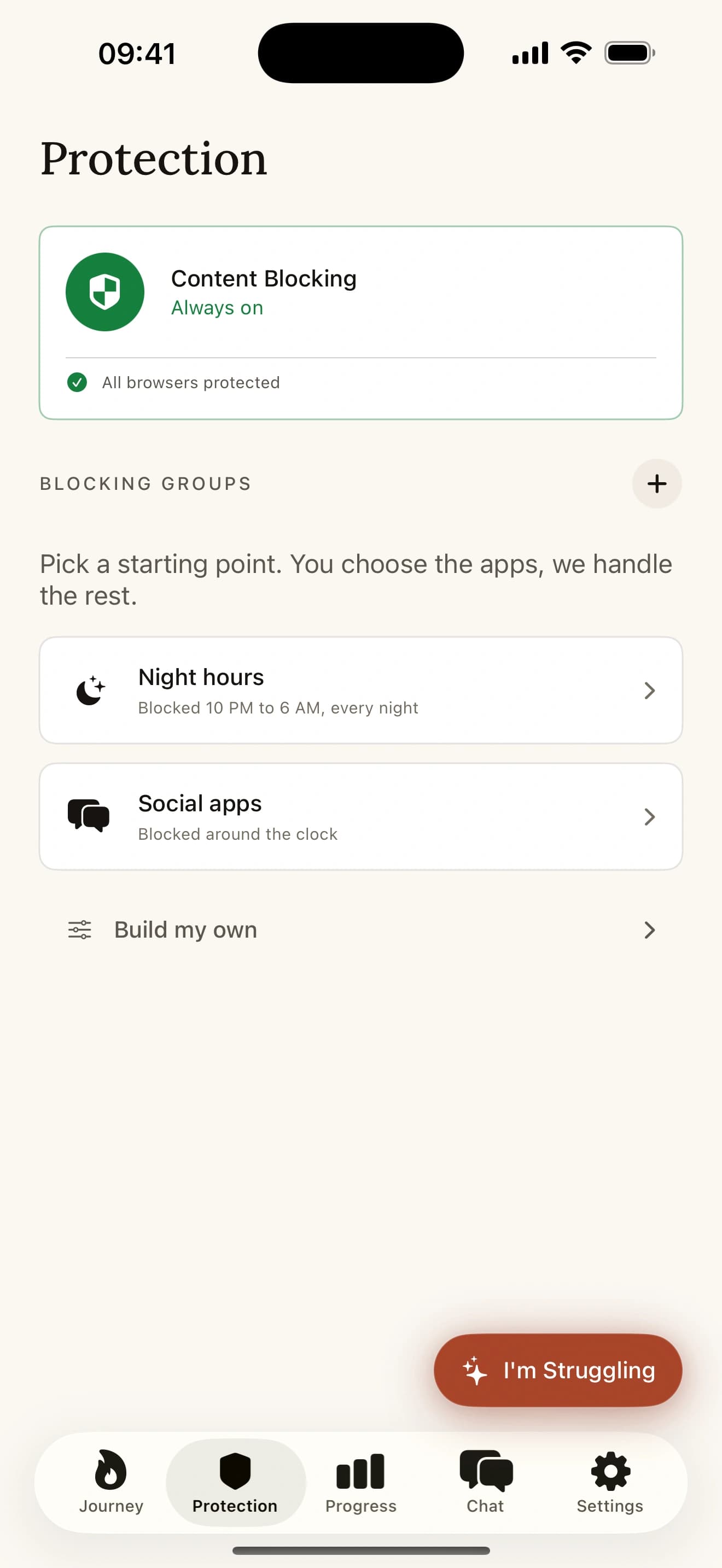
Help at the moment you slip.
North is an AI you open the moment you want to look. It already has your log and the time, so the conversation starts on the urge instead of on context. Nothing you send it leaves the app.
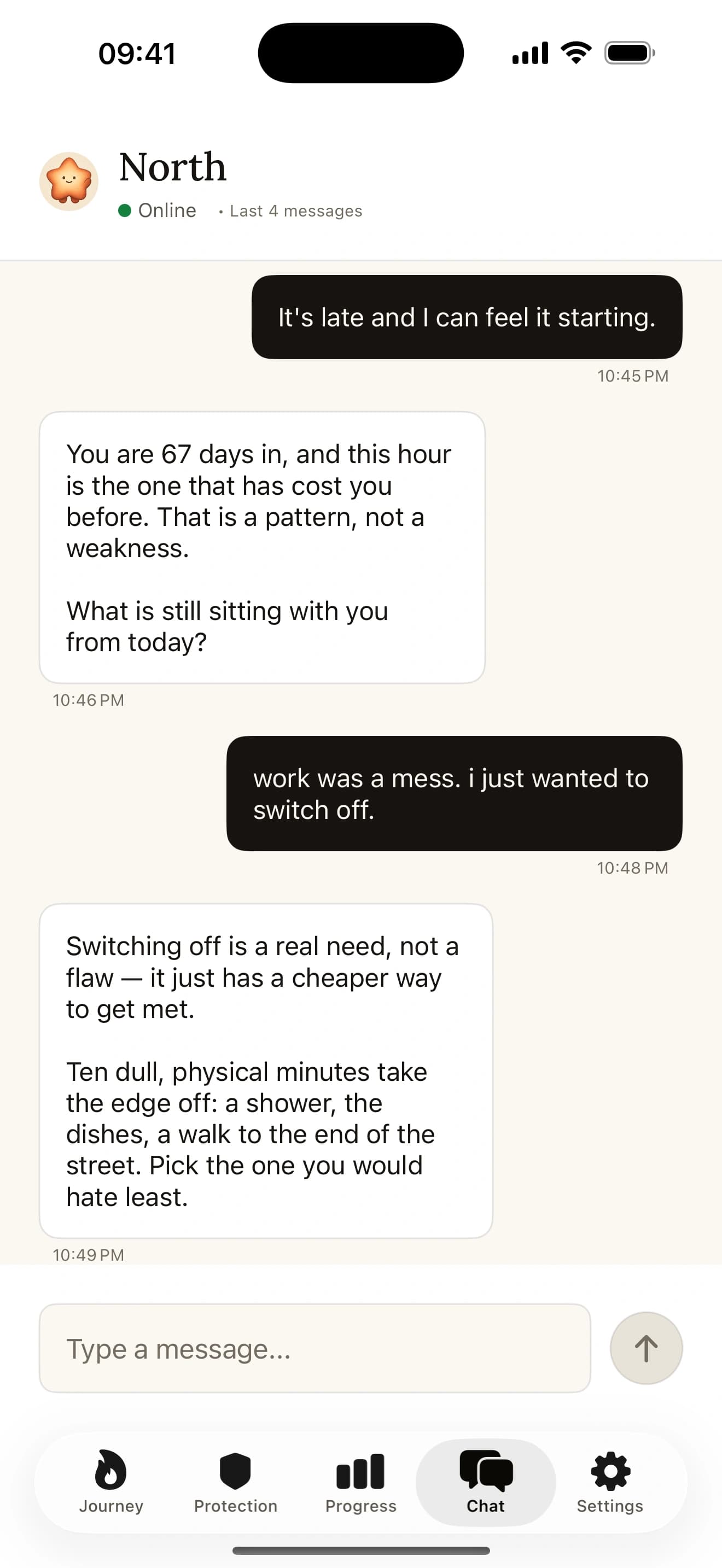
The hours you get back.
Days clean, your record, and the hours you have not spent on porn. Every number comes from your own log, so you can see whether this month is better than the last.
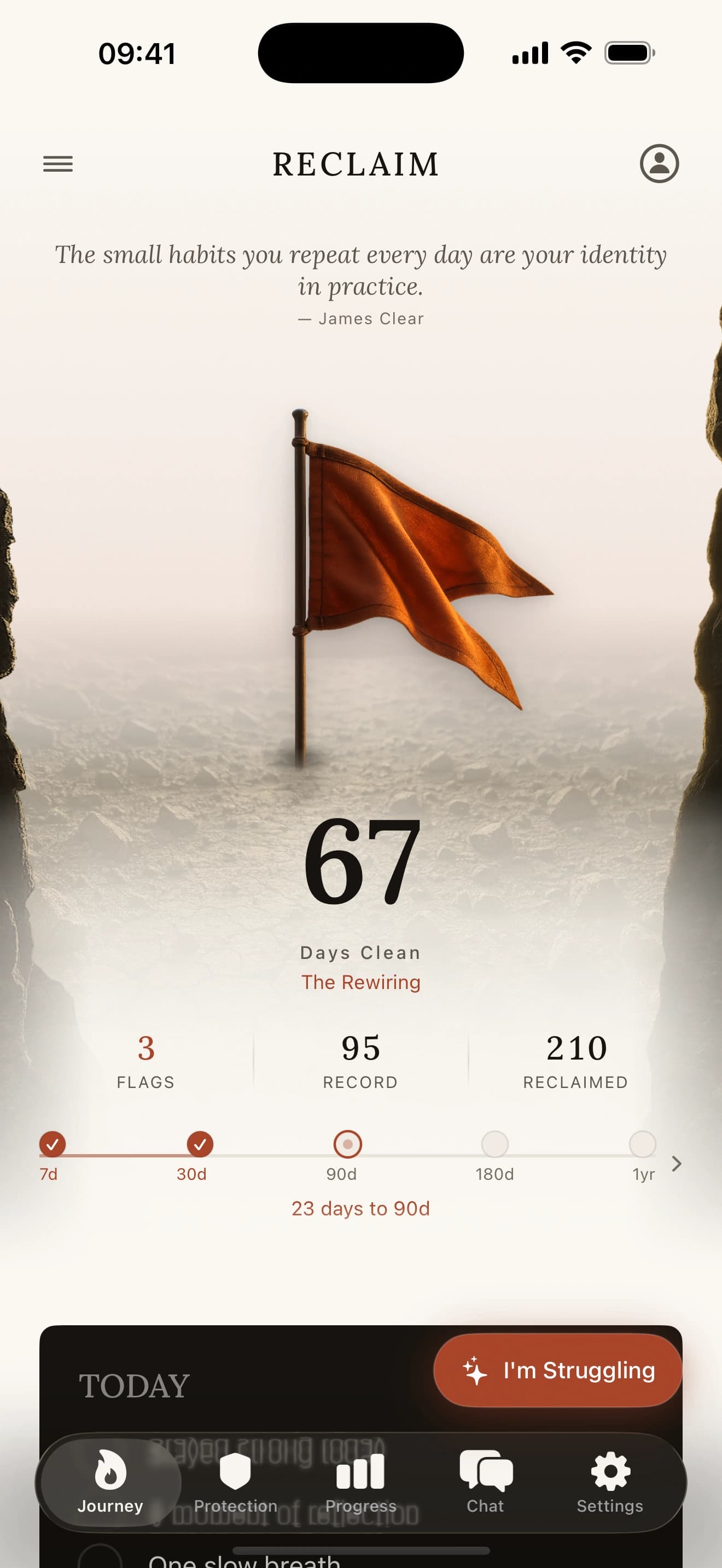
Milestones you keep.
You get an object at each milestone and it stays in the app. The cloth changes as the days add up. A slip resets the count and leaves the objects where they are.

Built on the evidence.
In 2022 the WHO formally classified Compulsive Sexual Behavior Disorder as a recognized mental-health condition: a persistent failure to control intense, repetitive sexual impulses that causes meaningful distress or impairment.
The compulsion has measurable patterns, and those patterns respond to particular interventions. The work the app is built on:
- University of CambridgeVoon et al., 2014
- Brain-activation patterns in men with compulsive sexual behavior mirror the cue reactivity seen in substance addiction (ventral striatum, dorsal anterior cingulate, amygdala).
- Yale School of MedicinePotenza, Sinha, et al.
- Behavioral addictions are sustained by the same stress and reward circuitry that drives substance use, and targeting stress regulation changes outcomes.
- Stanford UniversityReward and craving research
- Work on reward anticipation and craving-focused interventions informs how Reclaim treats the urge: not as an enemy to defeat, but as a predictable signal to watch and ride out.
Reclaim is informed by this research, not endorsed by these institutions, and is not medical treatment. If you are in crisis, talk to a licensed clinician.
Straight answers.
- Where does my data go?
- They stay with you. Nothing is sold and nothing is shared, and conversations with North are deleted after thirty days without you having to ask.
- Could I get around the block?
- Not quickly, and not by accident. It sits at the OS level and applies to any browser, not just Safari. The point was never to make anything unreachable — it is to make sure the fast, unthinking path does not end where it used to.
- Why not just use Screen Time?
- Screen Time is a timer that does not know what it is timing. This is the layer above it: North, which has your context, a way to log what happened, and numbers that tell you whether the last month was better than the one before.
- What does it cost?
- Free to download, and Premium starts with three days free. After that it is $4.99 a month or $39.99 a year, billed through the App Store.
- What happens if I slip?
- You log it, and it becomes evidence rather than a verdict. Time, mood, trigger. That is how the app learns which hour to close next.